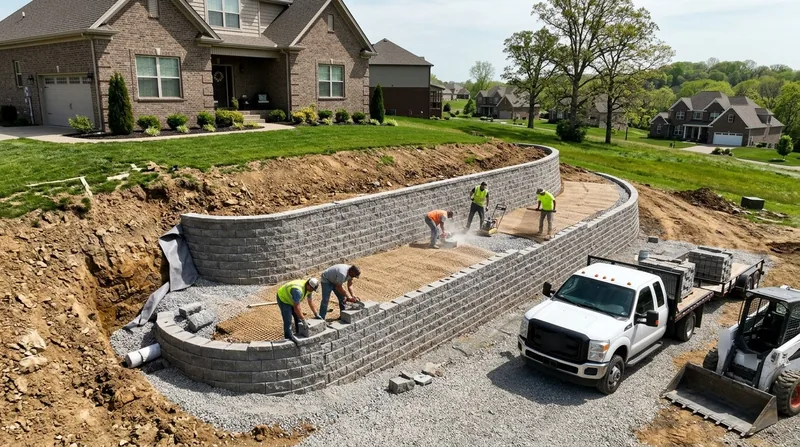




Lexington sits on rolling Inner Bluegrass ground where thin silty topsoil rests over sticky clay and karst limestone, so a wall that looks solid in July can lean by March. Block & segmental retaining walls in Lexington solve that problem with mortarless, engineered units and geogrid reinforcement instead of a rigid mass that fights the soil. We install Allan Block, Versa-Lok, and Keystone systems across Fayette County, from the curving streets of Chevy Chase to the newer two-story subdivisions in Hamburg and Masterson Station. A segmental wall flexes with freeze-thaw movement and drains through the block face, which is exactly what this clay-heavy ground demands. If your existing wall is already bulging or cracked, start with leaning and collapsed wall repair before we talk new construction.
Why Segmental Block Walls Make Sense on Lexington's Clay and Karst
Most wall failures we see in Lexington come from water, not from bad block. The clay subsoil here holds moisture through the wet spring, then swells and shrinks with fall dry spells and winter freeze-thaw, and that cycle pushes against any wall that cannot drain. Add sinkholes and shallow limestone in areas like Beaumont and Hartland, and you get settlement that opens joints and tips courses. A properly reinforced segmental wall handles both problems because the units move independently and the reinforced soil mass carries the load.
- We design the wall around your actual soil profile, not a one-size template.
- We install geogrid in lifts so the wall ties back into stable soil behind the failure zone.
- We build a gravel drainage chimney and perforated footing drain so clay-water never sits against the block.
- We cap the wall and compact each lift to limit settlement over the clay.
That combination is why segmental block outperforms poured concrete and timber on most residential lots in the Bluegrass.
Key info: A homeowner in the 40505 ZIP code had a 3-foot garden wall behind a Lansdowne ranch that heaved every February. We rebuilt it as a Versa-Lok wall with a gravel drain and geogrid, and it has held through three spring thaw cycles without a single shifted cap.
For the code side of things, check the Lexington-Fayette Urban County Government building department before you dig. Walls above roughly 4 feet from the footing, or walls that carry a driveway or structure surcharge, often need a permit and sometimes engineered drawings. Thresholds vary by jurisdiction, so verify with the department that has authority over your address.
How We Build a Segmental Wall on a Lexington Slope
Every job starts with the ground, not the block. We walk the site, check the slope above and below the wall line, and look for sinkhole activity or shallow rock that will change the footing depth. Then we set the base, which is the step most failed walls skipped. A segmental wall is only as good as its compacted gravel leveling pad.
- We excavate to stable soil and cut a leveling pad that follows the wall grade in steps.
- We compact the base in lifts and verify level before setting the first course.
- We lay the base course in Allan Block, Versa-Lok, or Keystone units and check alignment with a string line.
- We install geogrid at the engineered spacing and embed it in compacted backfill.
- We build the drainage chimney and daylight the outlet below the wall.
- We cap the wall, clean the face, and backfill the terrace to final grade.
The result is a wall that drains, flexes, and stays put through Lexington's wet springs and freeze-thaw winters.
Key info: On a Hamburg lot with a 6-foot grade change, we stepped a Keystone wall in two terraces with a planting bed between them. That cut the exposed wall height, reduced the geogrid requirement, and gave the homeowner usable flat yard instead of one tall face. See how we handle similar grades in our 40505 service area.
Segmental Wall Approaches We Use in Lexington
Not every lot needs the same system. The right choice depends on wall height, curve radius, load above the wall, and how much room you have to work with. Here is how the main approaches compare on Bluegrass ground.
| Approach | Description | Best for |
|---|---|---|
| Single-tier segmental wall | Mortarless block with geogrid and a gravel drain, built to 3 to 5 feet. | Garden walls and driveway edges in Southland and Lansdowne. |
| Terraced wall system | Two or more stepped walls with planting beds between tiers. | Lots in Hamburg and Masterson Station with 6 feet or more of grade. |
| Curved and radius wall | Tapered units that turn without cutting and keep the face clean. | Pool surrounds and curved patios in Beaumont and Hartland. |
| Surcharge-load wall | Heavier geogrid design for walls carrying a driveway or structure. | Driveway retaining walls and walkout basements near the Kentucky River gorge. |
We match the system to the load and the site, then build it the same way every time: base first, drainage second, block last.
Block & Segmental Retaining Walls Cost in Lexington: What to Expect
Most residential segmental walls in Lexington start around $25 per square foot of wall face, and that figure moves with height, access, and what sits above the wall. A low garden wall on open ground sits near the bottom of that range. A 6-foot wall carrying a driveway surcharge, with limited machine access through a narrow side yard, pushes toward the top and beyond. The square-foot number covers block, geogrid, gravel, drain pipe, and labor, but it does not cover engineered drawings or permit fees when those apply.
Access is the factor homeowners underestimate most. A wall we can reach with a mini excavator goes faster than one we have to feed by wheelbarrow through a Chevy Chase side gate. Soil conditions matter too: shallow limestone in a Hartland backyard may need rock breaking before the footing is cut. Get two or three written estimates on the same scope so you can compare what each one includes for drainage and reinforcement, not just the bottom line. Our full pricing overview breaks down how we build a number.
Hiring a Retaining Wall Contractor Near Me in Lexington: What to Check
Ask for proof of license and insurance before anyone sets foot on your property, and get the certificate sent to you directly. Walk at least one finished wall the contractor built two or more winters ago, because a wall that has been through Lexington freeze-thaw is a real reference. Confirm who pulls the permit and who pays for engineering if your wall crosses the 4-foot threshold or carries a surcharge.
Ask how they handle drainage, since that is where most local walls fail. If a bid has no gravel drain or geogrid line item, it is not the same job as one that does. HOA rules in subdivisions like Beaumont and Hartland may also dictate block color and wall height, so check before you order material. When you are ready to compare bids, contact us for a free estimate and we will walk the site with you.
Block & Segmental Retaining Walls in Lexington: Pricing Guide
| Service | Price | Details |
|---|---|---|
| Garden and low terrace wall | Starting at $25/sq ft | Covers block, geogrid, gravel drain, and labor for walls up to about 3 feet. |
| Taller structural wall | From $32 to $45/sq ft | Higher geogrid design and heavier block for walls 4 to 6 feet with surcharge loads. |
| Terraced and curved systems | On estimate | Multiple tiers and radius turns need a site walk to price the layout and access. |
| Engineered drawings and permits | Quoted separately | Required for tall or surcharge walls; cost depends on the jurisdiction and design. |
| Travel | Included | In Lexington and surrounding areas, with no separate call-out or mileage fee. |
| Estimate | Free | Response within 24 hours at (859) 710-8778, with no obligation to book. |
Indicative pricing, the exact cost depends on square footage, finish, and site access. Free personalized estimate within 24h at (859) 710-8778.


