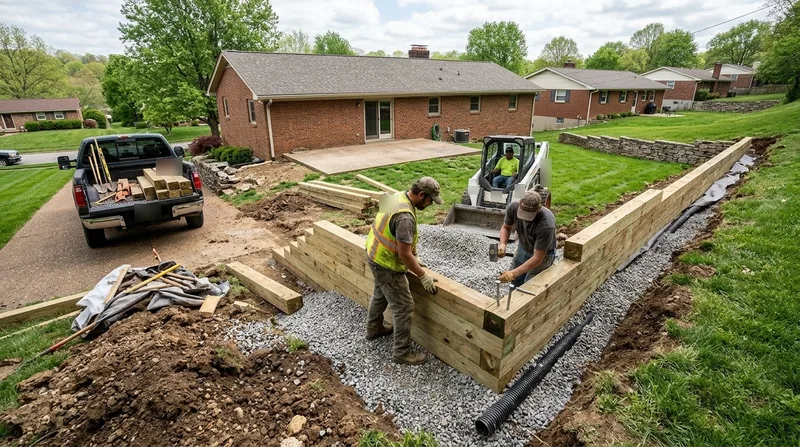




Timber Retaining Walls in Lexington
If you drive through Chevy Chase or Ashland Park, you will see the old dry-laid limestone fences holding back the banks. But in Southland, Lansdowne, and the 1970s subdivisions off Harrodsburg Road, you will find the other local standard: pressure-treated timber walls holding up garden beds and low terraces. Timber Retaining Walls in Lexington make sense when you need to hold back two to four feet of our silty topsoil and sticky clay without spending segmental block money. We build them, we repair them, and we tell you straight when a timber wall is a five-year fix versus a twenty-year one. If you are still weighing materials, our retaining wall installation page walks through the alternatives.
Why Timber Walls Still Work in Lexington's Bluegrass Soil
Our ground is thin silty topsoil over sticky clay sitting on karst Ordovician limestone. That clay holds water like a sponge after a heavy spring rain, and then the freeze-thaw cycles of January and February push on anything rigid. Timber handles that movement better than most people expect because it flexes instead of cracking. It is also the right call on the tight lots in Beaumont and Hartland where you cannot get a skid steer into the backyard.
- We set timber walls for garden beds, low terraces, and driveway edging where the height stays under four feet.
- We use ground-contact rated pressure-treated lumber, not landscape timbers from a big-box pallet.
- We build in proper drainage gravel and a perforated pipe so the clay water does not sit against the wood.
- We tell you when the grade, the surcharge, or the soil says you need block or concrete instead.
Timber is a budget tool, and we treat it that way. It buys you a solid ten to fifteen years in our climate when it is built right and drained right.
Key info: A timber wall on a Southland lot that holds back a saturated clay bank with no drainage will rot from the back face in five to seven years. The same wall with gravel, filter fabric, and an outlet pipe lasts twice as long.
For permit thresholds and setback rules, always verify with the Lexington-Fayette Urban County Government building department before you dig. Walls above roughly four feet, or walls carrying a driveway or structure, usually need a permit and sometimes engineered drawings.
How We Build a Timber Wall That Survives Kentucky Winters
We start by digging to the clay, not stopping in the topsoil. A timber wall founded on six inches of loose silt will lean by the second spring. We set the first course on compacted gravel, then we build the drainage behind the wall as we stack, not after. Every wall we build in Georgetown or Nicholasville gets the same sequence.
- We mark the wall line and call in the utility locate before any digging starts.
- We excavate to stable subsoil and compact a gravel footing for the base course.
- We set the first timber course level and dead straight, because every course above it inherits that line.
- We install filter fabric, washed gravel, and perforated drain pipe behind each lift as we stack.
- We stagger the joints, pin the courses where the design calls for it, and tie the wall back into the slope.
- We backfill in lifts and compact, then grade the top so water runs away from the wall face.
If the wall is failing already, our leaning and collapsed wall repair crew can often save the structure before it goes over.
Key info: On a Versailles property last spring, a homeowner's 1980s timber terrace had rotted through at the base while the top three courses looked fine. We pulled the wall, found the drain pipe clogged with clay fines, and rebuilt it with clean gravel and a new outlet. The visible lumber told the wrong story.
Timber Wall Approaches We Use in Lexington
Not every timber wall is the same build. The right approach depends on height, how wet the bank stays, and whether anything heavy sits above the wall. Here is how we match the method to the site.
| Approach | Description | Best for |
|---|---|---|
| Stacked timber with deadman anchors | Pressure-treated courses tied back into the slope with buried anchors and gravel backfill. | Terraces two to four feet high on clay banks. |
| Timber garden bed wall | Low single or double course wall with fabric and gravel behind it. | Raised beds and low grade changes in Chevy Chase yards. |
| Tiered timber terrace | Two or three stepped walls with setbacks and drainage between each lift. | Sloping backyards in Masterson Station and Hamburg. |
| Timber to block conversion | Remove rotted timber and rebuild in segmental block where the wall must last. | Walls over four feet or carrying a surcharge. |
We will tell you at the estimate which of these fits your site, and we will not upsell block where timber genuinely does the job.
Timber Retaining Walls Cost in Lexington: What to Expect
Most timber walls in Lexington start around $20 per square foot of wall face, and that figure moves with height, access, and how much excavation the site needs. A low garden bed wall on a flat Chevy Chase lot sits at the bottom of that range. A tiered terrace on a steep Hamburg slope with tight equipment access sits well above it. The square-foot number also depends on whether we are removing an old railroad tie wall first, which adds disposal and hauling.
Get two or three written estimates before you commit. A contractor who quotes a timber wall without asking about drainage or soil is quoting a wall that will fail. Our full pricing overview breaks down what drives the number so you can compare bids on equal terms.
Timber Retaining Walls Near Me: Hiring a Contractor Near Lexington
You want a contractor who carries liability insurance and workers' compensation, and who will show you the certificate before work starts. Ask for local references on timber walls at least three years old, because a new wall looks good on day one. Confirm who pulls the permit if your wall crosses the four-foot threshold, and check any HOA architectural rules before the first board comes off the truck.
- Verify the license and insurance certificate, and call the insurer if the paperwork looks generic.
- Get at least two written estimates that itemize drainage, excavation, and disposal separately.
- Ask to see a timber wall the company built at least three winters ago.
- Confirm the permit responsibility in writing before the crew mobilizes.
When you are ready to talk through your wall, reach out through our contact page and we will set up a site visit.
Timber Retaining Walls in Lexington: Pricing Guide
| Service | Price | Details |
|---|---|---|
| Low timber garden bed wall | Starting at $20/sq ft | Includes pressure-treated lumber, gravel footing, filter fabric, and drainage backfill for walls under two feet. |
| Standard timber terrace wall | Starting at $28/sq ft | Includes deadman anchors, perforated drain pipe, and compacted lifts for walls two to four feet high. |
| Tiered timber terrace system | Starting at $35/sq ft | Includes stepped setbacks and separate drainage runs for each lift on sloping Lexington yards. |
| Timber wall removal and rebuild | On estimate | Rotted timber, clogged drains, and hauling costs vary by site, so we price after an on-site look. |
| Travel | Included | in Lexington and surrounding areas, no separate call-out or mileage fee. |
| Estimate | Free | Response within 24h at (859) 710-8778, no obligation to book. |
Indicative pricing, the exact cost depends on square footage, finish, and site access. Free personalized estimate within 24h at (859) 710-8778.


