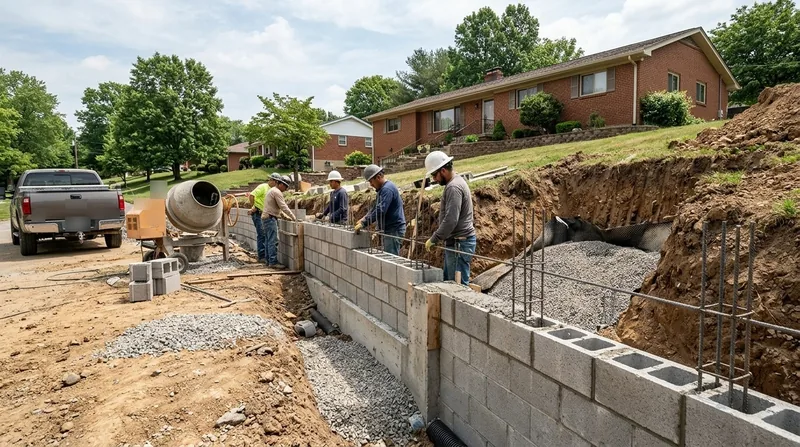




Concrete Retaining Walls in Lexington
Lexington sits on the rolling Inner Bluegrass, where a thin layer of silty topsoil rests on sticky clay over karst Ordovician limestone. That geology decides how retaining walls behave here: water perches in the clay, sinkholes open under footings, and freeze-thaw cycles work joints loose every winter. Concrete Retaining Walls in Lexington handle those conditions better than any other system, because a poured or reinforced CMU wall with an engineered footing resists both the lateral clay pressure and the settlement that comes with shallow rock and voids. From the brick townhouses around Gratz Park to the steep driveways of Chevy Chase and the newer subdivisions in Hamburg and Masterson Station, we build walls that hold the grade and keep the water moving. If you are comparing systems, our retaining wall installation page explains how we choose between concrete, block, and natural stone.
Why Concrete Walls Make Sense on Lexington's Clay and Limestone
Most wall failures we see in Lexington are water failures, not material failures. The clay subsoil holds spring rain like a sponge, and once it saturates, it pushes hard against the back of the wall. Add the freeze-thaw cycle that runs from December into March, and timber walls rot, block walls bulge, and dry-laid stone fences lean. Concrete walls, when built with proper drainage, carry that load without moving.
- Poured concrete resists the high lateral pressure that saturated Bluegrass clay puts on a wall.
- Reinforced CMU walls handle tight lots near downtown where an excavator cannot reach the back of the wall.
- Concrete does not rot, so it outlasts the railroad tie terraces still standing in Lansdowne and Southland.
- Engineered footings can be designed around shallow rock and sinkhole risk in the karst areas south of town.
For homeowners in Ashland Park and Chevy Chase, a concrete wall also keeps a clean, straight line that suits the 1920s and 1930s architecture.
Key info: A poured wall on Man o' War Boulevard failed after two seasons because the builder backfilled with clay and skipped weep holes. The replacement used washed gravel, a perforated drain, and a concrete wall tied to an engineered footing. It has not moved since.
For permit thresholds and inspection requirements, start with the Lexington-Fayette Urban County Government building department, since local rules vary by wall height and surcharge.
How We Build a Concrete Retaining Wall in Lexington
We start with the soil, not the wall. A concrete wall is only as good as its footing and its drainage, and in Lexington that means digging below the clay to something that will not move. We check for shallow rock and sinkhole indicators before we set a grade, then we build the wall in a sequence that keeps the site stable throughout.
- We walk the site and measure the slope, the surcharge loads, and the access for equipment.
- We call for utility locates and confirm whether the wall needs a permit or engineered drawings.
- We excavate to the footing depth and pour a reinforced concrete footing sized for the wall height and soil.
- We set rebar and form or lay reinforced CMU block, depending on access and finish.
- We install weep holes and a gravel drainage chimney behind the wall, tied to a footing drain.
- We backfill in lifts with compactable material, not the clay we dug out.
- We finish the face and cap, then clean the site and walk the wall with you.
On a recent job off Tates Creek Road, we built a 5-foot poured wall along a driveway that had been washing out every spring. The fix was a deeper footing on the rock and a drainage line that daylights at the street.
Key info: In the Kentucky River gorge south of Lexington, palisade cliffs and steep swales make access the main constraint. We have poured walls in sections and pumped concrete when a truck could not get within reach.
If the wall is part of a larger grade problem, our slope stabilization and erosion control service covers the soil above and below the wall.
Concrete Wall Methods We Use Around Lexington
Not every site calls for the same concrete system. Access, wall height, finish, and budget decide whether we pour in place, lay reinforced block, or combine concrete with a stone face. The table below shows how we match the method to the property.
| Approach | Description | Best for |
|---|---|---|
| Poured concrete wall | Formed and poured in place with rebar and an engineered footing. | Tall walls, driveway surcharges, and tight lots near downtown. |
| Reinforced CMU block | Concrete block laid and grouted with vertical and horizontal rebar. | Sites where a concrete truck cannot reach the wall line. |
| Concrete with stone veneer | Structural concrete face finished with limestone or manufactured stone. | Historic districts and homes that want a dry-laid limestone look. |
| Tiered concrete walls | Two or more shorter walls stepped up a slope with drainage between tiers. | Steep Bluegrass grades and terraced yards in older neighborhoods. |
| Concrete repair and underpinning | New footing, drainage, and face repair for a wall that has moved. | Leaning or cracked walls that can be saved instead of replaced. |
Whichever method fits, the drainage detail stays the same, and that detail is what keeps the wall standing.
Concrete Retaining Walls Cost in Lexington: What to Expect
Concrete retaining walls in Lexington start around $35 per square foot of wall face, measured from the footing to the top. That figure covers a straightforward poured wall with a standard footing, rebar, weep holes, and gravel backfill. The final number depends on height, access, soil conditions, and whether the wall carries a driveway or structure.
- Wall height drives cost fastest, because footing depth and rebar sizing increase with every foot.
- Tight access in Chevy Chase or the North Side means hand digging and smaller equipment, which adds labor.
- Shallow rock or sinkhole risk may require rock excavation or a deeper engineered footing.
- A surcharge load, such as a driveway or garage above the wall, calls for engineering and a heavier section.
- Stone veneer and custom caps add a finish cost on top of the structural price.
Get two or three written estimates and compare the footing and drainage details, not just the total, because a cheap wall with no drainage will cost more in five years. Our pricing page breaks the numbers down further.
Choosing a Concrete Retaining Wall Contractor Near Me in Lexington
Hiring the right contractor matters more for concrete than for any other wall type, because the work you cannot see (footing, rebar, drainage) decides whether the wall lasts. Ask for proof of license and insurance, and confirm the policy covers retaining wall work specifically. Get at least three estimates and ask each contractor how they handle water behind the wall.
- Verify the license and insurance certificate before any work starts.
- Ask for references from walls of similar height and soil conditions in Lexington.
- Confirm who pulls the permit and whether engineered drawings are required for your wall height.
- Check HOA rules in subdivisions such as Beaumont or Hartland before choosing a finish.
- Get the drainage scope in writing, including weep holes and the footing drain.
Reach us through our contact page to schedule a free estimate.
Concrete Retaining Walls in Lexington: Pricing Guide
| Service | Price | Details |
|---|---|---|
| Poured concrete retaining wall | Starting at $35/sq ft | Includes engineered footing, rebar, weep holes, and gravel backfill; height and access move the price. |
| Reinforced CMU block wall | Starting at $38/sq ft | Includes grouted block, rebar, and drainage; tight sites with no truck access cost more. |
| Concrete wall with stone veneer | Starting at $55/sq ft | Includes structural concrete face plus limestone or manufactured veneer and cap. |
| Leaning or cracked wall repair | On estimate | Needs an on-site look to judge footing condition, drainage, and whether the wall can be saved. |
| Travel | Included | In Lexington and surrounding areas, no separate call-out or mileage fee. |
| Estimate | Free | Response within 24h at (859) 710-8778, no obligation to book. |
Indicative pricing, the exact cost depends on square footage, finish, and site access. Free personalized estimate within 24h at (859) 710-8778.


