Why Lexington's Soil and Geology Demand the Right Retaining Wall Material
If you live in Lexington, you already know that our landscape is beautiful but challenging. The famous Bluegrass clay is expansive, meaning it swells when wet and shrinks when dry, putting constant pressure on any structure that holds back soil. Beneath that clay, you often find karst geology with shallow limestone bedrock, which can complicate excavation and drainage. Choosing the wrong material for a retaining wall here is not just a cosmetic mistake; it can lead to failure, costly repairs, and safety hazards.
That is why local knowledge matters. A retaining wall that performs well in sandy coastal soil may not last a season in Central Kentucky. At Lexington Retaining Wall, we understand how these local conditions interact with different materials. Whether you are planning a new garden terrace, a driveway support wall, or a full erosion control solution, the material you select must handle hydrostatic pressure from clay, integrate with limestone conditions, and provide reliable drainage. In this article, we break down the top materials for our area and help you understand which one fits your project best.
Concrete Retaining Walls: Strength for Expansive Clay
Concrete Retaining Walls are a top choice for Lexington homeowners dealing with heavy clay. Poured concrete offers exceptional mass and compressive strength, making it ideal for taller walls and situations where soil pressure is significant. Because Bluegrass clay expands with moisture, a concrete wall designed with proper reinforcement and weep holes can resist lateral forces that would crack or bulge weaker materials. Concrete also offers a clean, modern look and can be textured or stained to blend with your home's exterior.
However, concrete is not a one-size-fits-all solution. Proper installation is critical: the footing must extend below the frost line, and drainage behind the wall must be carefully engineered to prevent water buildup. Without these steps, even a strong concrete wall can fail. For homeowners who want a durable, low-maintenance wall that stands up to Kentucky's freeze-thaw cycles and clay soils, concrete is often the best long-term investment. If you are unsure whether concrete suits your site, our team can evaluate your soil and slope during a free estimate.
Block Retaining Walls and Segmental Retaining Walls: Versatility and Drainage
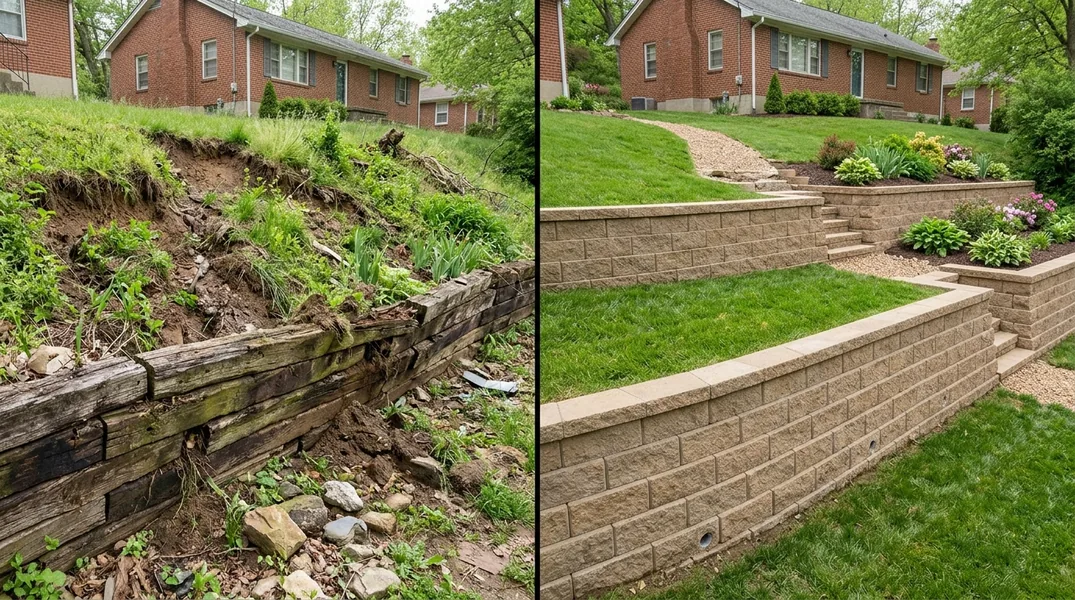
Retaining Wall Installation using block systems has become increasingly popular in Lexington and surrounding areas like Georgetown. Block retaining walls, especially segmental retaining walls (SRWs), are engineered with interlocking units that flex slightly under pressure, which can be an advantage in expansive clay. These systems also feature built-in drainage channels and are often faster to install than poured concrete. Many homeowners appreciate the wide variety of colors, textures, and cap styles available, allowing the wall to complement their landscaping.
Segmental retaining walls are particularly well-suited to sites with shallow limestone, where excavation is difficult. Because they are built from smaller units, they can adapt to uneven bedrock and reduce the need for heavy digging. That said, proper base preparation and backfill with free-draining gravel are essential. If a block wall is not installed with adequate drainage, clay particles can clog the system and lead to settlement. For a wall that balances aesthetics, flexibility, and performance, block and segmental systems are an excellent choice. Our team can help you select the right block for your soil conditions and slope height.
Limestone Retaining Walls: A Natural Fit for Karst Terrain
A Retaining Wall Replacement project often presents the opportunity to use local limestone, a material that feels right at home in the Bluegrass. Limestone retaining walls are naturally beautiful and tie into the region's architectural heritage. More importantly, limestone is abundant here, and using local stone can reduce transportation costs and environmental impact. In karst areas with shallow bedrock, limestone walls can be designed to work with the existing geology rather than fighting it.
However, limestone walls require skilled craftsmanship. Dry-stacked limestone walls rely on gravity and friction, while mortared walls need proper footings and drainage to prevent water from eroding the mortar over time. Because limestone is porous, it can be susceptible to freeze-thaw damage if not properly sealed or if water is allowed to saturate the stone. For homeowners in Nicholasville or Richmond, a limestone wall can be a stunning and durable choice when installed by experienced professionals. We can help you decide if limestone is the right fit for your site's drainage and soil conditions.
Retaining Wall Installation Near Me: When to Call a Pro
While DIY retaining walls are popular for small garden beds, the combination of expansive clay, karst features, and shallow limestone in Lexington means that many projects require professional expertise. A wall that is improperly sized, lacks adequate drainage, or is built on an unprepared base can fail within a few years, costing you far more than the original installation. If your wall will be taller than three feet, support a driveway or structure, or manage significant water flow, it is time to call a professional.
At Lexington Retaining Wall, we specialize in designing and installing walls that work with our local geology. We start with a site evaluation to assess soil, slope, and drainage, then recommend the best material for your needs and budget. Whether you need a new wall, Retaining Wall Repair for an existing structure, or a full replacement, we are here to help. Call us at (859) 710-8778 or visit our website to schedule a free estimate and get expert advice tailored to your property.
Looking for a professional retaining wall contractor in Lexington? Lexington Retaining Wall responds fast for all your retaining wall needs.
Get a Free QuoteOur services: Retaining Wall Installation · Retaining Wall Repair · Retaining Wall Replacement