The Hidden Geology Under Your Lexington Yard
If you live in Lexington, you already know that our beautiful bluegrass landscape comes with a few quirks. The same soil that makes horse farms famous is also one of the most challenging environments for any structure that has to hold back earth. The top layer of bluegrass clay is dense and sticky when wet, yet it shrinks and cracks dramatically during dry spells. Beneath that clay, you often hit limestone bedrock at unpredictable depths. This combination creates a one-two punch for retaining walls: water does not drain through the clay quickly, and the limestone shelf can trap moisture against the back of your wall.
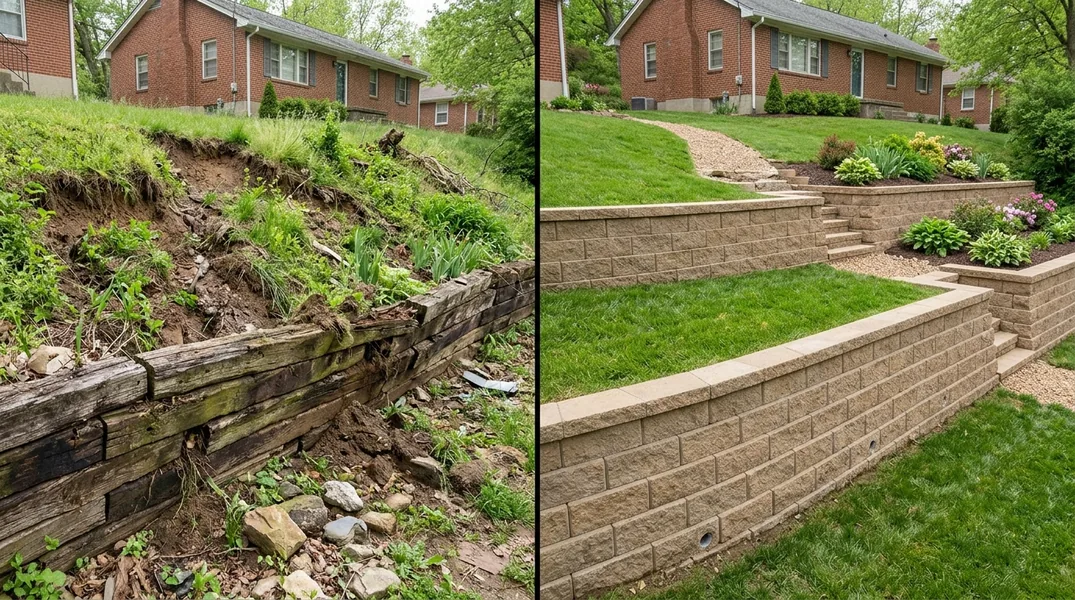
When a wall is installed without accounting for these local conditions, hydrostatic pressure builds up behind it. That pressure is the single most common cause of a failing retaining wall in our area. Many homeowners first notice a leaning retaining wall or a bowing retaining wall after a wet spring, but the problem actually started the day the wall was backfilled with the wrong material or without proper drainage. Understanding this geology is the first step to protecting your investment.
Warning Signs You Should Never Ignore
Retaining walls rarely collapse without warning. They give you clues, often months or years in advance. The most obvious sign is a wall that has started to lean away from the hillside or toward it. A slight tilt might seem harmless, but it usually means the footing is moving or the soil behind the wall is saturated. Another red flag is a bowing retaining wall, where the middle of the wall pushes outward in a curve. This is classic hydrostatic pressure, and it will not correct itself. You may also see horizontal cracks in concrete, separated mortar joints in block walls, or soil washing out from under the base.
Less visible but equally important are drainage issues. If you notice water pooling at the base of the wall, or if the weep holes are clogged with clay and roots, the wall is holding water it was never designed to hold. In Georgetown and Nicholasville, we see the same pattern: a wall that looked fine for a decade suddenly shows movement after a record rainfall. If you spot any of these signs, it is time to call a professional for a Retaining Wall Repair assessment before the damage worsens.
Why DIY Fixes Usually Make Things Worse
It is tempting to patch a crack or add a few blocks to a leaning wall, but retaining walls are engineered systems, not decorative fences. A wall that is bowing or leaning has already lost the support of the soil behind it. Adding weight or rigid patches to the face of the wall can accelerate failure by concentrating pressure in new areas. We have seen homeowners in Richmond try to jack a wall back into place, only to crack the footing and create a larger problem. The correct fix almost always involves addressing the soil, the drainage, and the footing, not just the visible surface.
Proper repair may involve installing new drainage behind the wall, replacing failed backfill with gravel, or rebuilding sections with geogrid reinforcement. In some cases, the most cost-effective solution is a full Retaining Wall Replacement using a system designed for our clay and limestone. A professional assessment will tell you which path makes sense for your budget and your landscape.
Retaining Wall Repair Near Me: When to Call a Pro
If you are searching for retaining wall repair near me in Lexington, you are probably already past the “wait and see” stage. Any wall that is leaning more than a few degrees, showing a visible bow, or has cracks wider than a quarter inch should be evaluated by a professional. Do not wait for the wall to fail completely, because a collapsed wall can damage landscaping, driveways, and even foundations. The cost of emergency removal and rebuild is almost always higher than a planned repair.
At Lexington Retaining Wall, we start with a thorough inspection of the wall, the soil, and the drainage. We explain what is happening in plain language and give you options. Whether you need a targeted repair or a new Retaining Wall Installation built for local conditions, we can help. Call us at (859) 710-8778 to schedule a free estimate and get a clear picture of what your wall needs.
Building It Right the First Time
The best way to avoid a failing retaining wall is to build it correctly from the start. That means excavating deep enough to reach stable soil, using compacted gravel for the base, installing proper drainage (not just a few weep holes), and using geogrid to tie the wall into the hillside. For taller walls, Concrete Retaining Walls often outperform block because they resist the lateral pressure of saturated clay more effectively. The right choice depends on the height of the wall, the slope, and how you want the finished wall to look.
We also recommend planning for water from the start. Gutters, downspouts, and surface grading all affect how much water reaches your wall. A wall that is designed with the local hydrology in mind will last decades longer than one that is simply built to look good. If you are considering a new wall or want to know what a proper repair would involve, reach out for a pricing consultation. We are happy to walk you through the options and help you protect your property.
Looking for a professional retaining wall contractor in Lexington? Lexington Retaining Wall responds fast for all your retaining wall needs.
Get a Free QuoteOur services: Retaining Wall Installation · Retaining Wall Repair · Retaining Wall Replacement